Collaborative innovation drives the UK TV market

Author

Elliott Millard
Chief Strategy Officer,
Thinkbox
TV advertising is set to become even easier to buy, as Channel 4, ITV, and Sky announce a joint marketplace launching in 2026. This collaboration aims to streamline access and simplify transactions across broadcasters, marking a major step forward in the evolution of TV ad buying.
What are the major updates in the UK’s TV and advertising market this year?
There has been lots of big news in commercial TV recently – which grew in the UK last year to £5.27 billion – much of it centred around innovative collaboration. Two initiatives stand out: TV advertising is about to get even easier to buy following the announcement that Channel 4, ITV, and Sky – through Comcast Advertising – are launching a new advertising marketplace in 2026. For the first time, small-to-mediumsized businesses (SMBs) will be able to run a single campaign across all three platforms.
Meanwhile, Lantern – the cuttingedge measurement and reporting solution for the UK TV advertising market – is in rapid development. It will enable agencies and advertisers to track the online responses, and actions triggered by TV.
We expect to update the industry on next steps in the final quarter of this year, so stay tuned.
Can you elaborate on the research presented?
Context Effects” identified six factors that explain some 79 per cent of the variation people have in recalling advertising. They were:
- Location: the living room emerged as the most impactful location, driving 22 per cent higher ad recall than all other rooms in the house and 176 per cent higher than the kitchen.
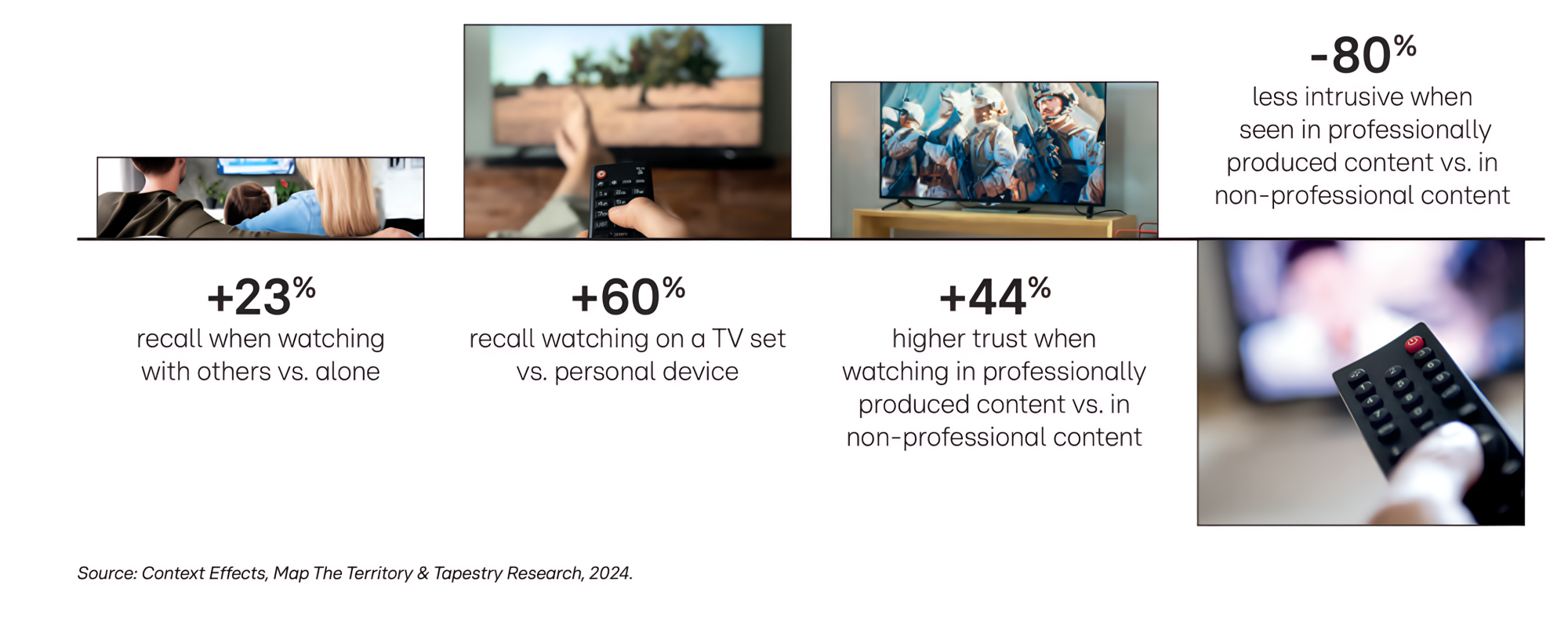
- Device: the TV screen drives highest ad recall of all devices (34 per cent more than ads seen on a computer, and 60 per cent more than a tablet or smartphone).
- Shared viewing: watching with others boosts ad recall by 23 per cent compared with watching alone; as well as encouraging conversations about products, and brands seen.
- Content: ads seen in professionally produced content drive 60 per cent higher recall compared with ads seen in non-professional content. Ads seen in professionally produced content are also felt to be 44 per cent more trustworthy, 39 per cent more entertaining, and 80 per cent less intrusive.
- Mood: ad recall peaks when viewers are relaxed (+14 per cent), happy (+41 per cent), and connected (+49 per cent).
- Satisfaction with the occasion: this was the strongest factor influencing ad recall, with each of the other five factors also enhancing this element. “Context Effects” found that the best combination of contexts are: watching professionally-produced content, in the living room, on a TV set, with others, and feeling satisfied with the occasion. By contrast, the worst combination of factors is: watching non-professionally-produced content, in the kitchen, alone. The right in-home advertising context can increase recall by up to 6.3 times. Context matters – and it has real value for advertisers.
What will your company be doing next year, are there any big projects to look out for?
We are incredibly busy delivering our programme – from the fantastically popular TV Masters training course, to spending as much time as possible with agencies and advertisers, talking about TV’s transformation and what TV advertising can now do. We are also permanently ready to react to the latest misinformation about TV.
One thing we are particularly excited about is our new study Staying Power, which explores the dynamics of how advertising effects decay over time, and what advertisers can do to help maintain them for longer. It is the goal of all brands to drive both immediate and sustained purchase intent, so we are expecting a lot of interest when we launch this at the end of the year.
"Context Effects" by Thinkbox
An obsession with ad view quantity over quality was diverting spend from publisher media like TV towards “non-publisher” platforms, like social. TV needed to prove its contextual value to advertisers. “Context Effects” did just that, using an innovative blend of research techniques to show how TV uniquely delivers the best in-home advertising environment.
The living room has the highest ad recall
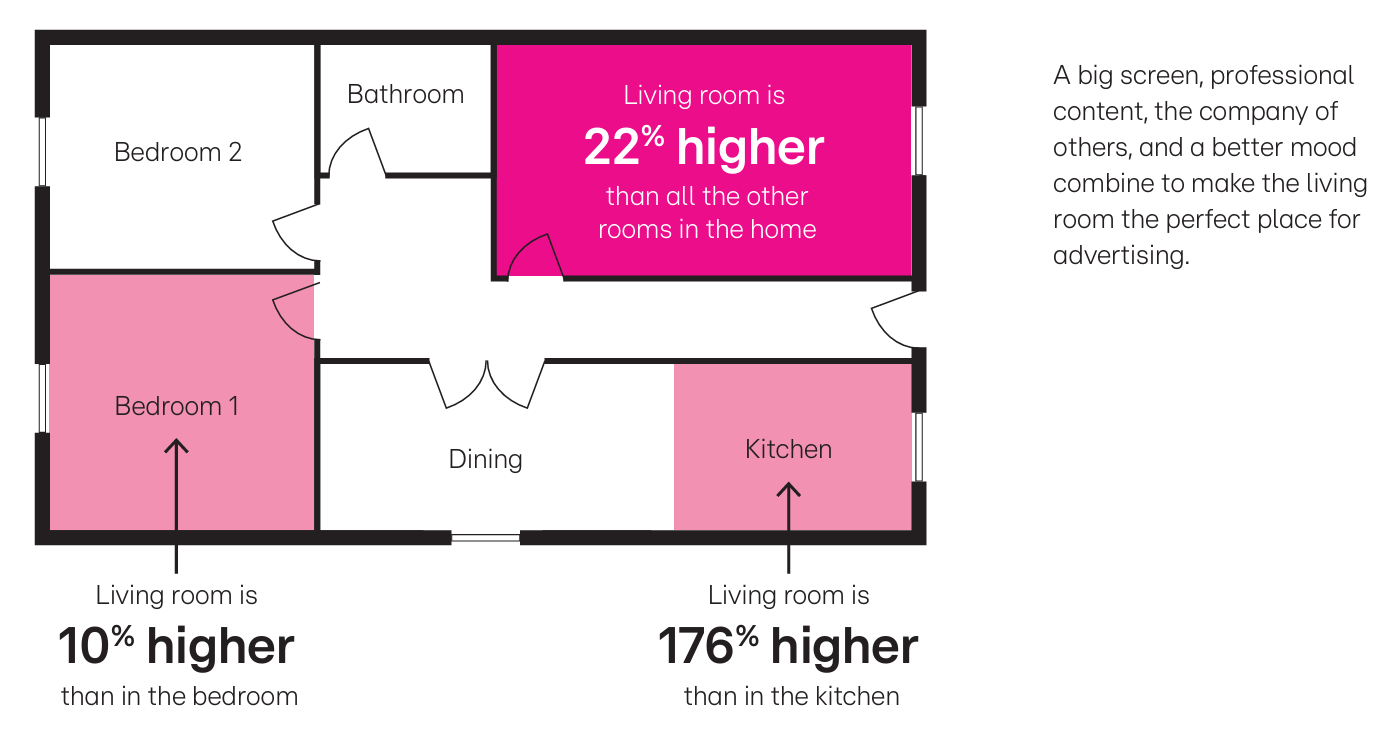
The right in-home advertising context can increase ad recall by up to 6.3 times